
I'm actually a supporter of increased government surveillance.
My friends know that whenever I go to events, I rarely take pictures. I am the un-documentarian. And thus, I have suffered, as my episodic memory is not that great. I think the federal government should improve their tracking and satellite surveillance abilities. That way, I can have great photos and videos of myself wherever I go, 24 x 7, and never have to worry about bringing along a camera. They should also improve their internet traffic monitoring systems to snoop on my network activity, so that I never have to backup my e-mail files again. While they're at it, monitor all my financial transactions so that they can do my taxes for me automatically every year.
If you're reading this blog post, federal government, also consider this: After you've started collecting this huge database you can then create a premium level web service. Allow users to pay an annual subscription fee to log in with their federal credentials. You might even make some money off this and start paying back that deficit. I'd totally use this service as it's much more likely for the U.S. government to be in business in the long term than Flickr or Picassa.
UPDATE: http://io9.com/5191353/what-happens-when-security-cameras-get-involved-with-matchmaking
Saturday, February 21, 2009
3
Wednesday, February 04, 2009
0
Monday, December 29, 2008
1
War On Demand
 Peace Fail.
This will not be a short operation. The war on terrorism is an ongoing one, and we will have to stand firm in order to change the situation in the south...I am confident that the American government would not have waited one day before they would have responded if San Diego would have been bombed or shelled or rocketed from Tijuana (Mexico) with thousands of rockets.Sound familiar? Who would have thought that the Bush Doctrine of "bomb first and ask questions later" could be invoked by other countries as well? It seems things have devolved into "if the US can do it, then so can we." Meanwhile, Condoleezza Rice said yesterday that soon we will start to thank G.W.B. for what he's done for America. I guess we can start now. He did help get the first black President elected.

Wednesday, December 03, 2008
0
The Nature of Fish

THE NATURE OF FISHSwirling and falling down from the glimmering surface
A school of fish spiral down in synchronized dance,
Tunneling into a dark, watery abyss. White fish,
Black fish, their souls darken as they approach
The nadir, each midlessly following his
Leader, continuing the structure of
Fish rules and Fish society.
They never recognize
The Truth. There is
No control,
No will.
Monday, December 01, 2008
6
Icarus
 This weekend, I came across an old tape backup of my old files. In the mass of outdated document formats, I came across some poems that I wrote back in high school, more than a decade ago. I'll start posting them here.
ICARUS
You may think me foolish, or rash,
As youth are prone to disregard the advice of elders.
You say, my wings have not hardened, that I am not ready to alight.
You warn me to hold a steady course, to keep to the middle.
But, I value adventure over safety.
I long for the exhiliration of the whistling winds beneath me and the freedom of unrestrained motion.
For the chance to soar among the eagles,
I would spit in the face of danger because I realize that many never attain such an opportunity.
No, Daedalus, old man, I prefer not to choose the middle path.
I long for this chance to steal divine insight.
You see, this is much more than a flight from this wretched place, it is an emancipation.
Look, Daedalus, watch how high I can soar!
Higher, and higher, and higher, as far as my breath can sustain me.
I will reach the sun. I will go beyond the sun, into the heavens, and escape from the pull of the Earth, which is humanity's bane.
But, what? Oh, no. It's seems my wings have deteriorated.
Cursed Apollo. They're playing a cruel prank on me.
Because they can't stand mortal intruders or boys with wings.
So, I fall.
Down into the violent, freezing waters below.
I will die soon.
However, you never even knew what life was.
Life is not measured in years, but in split-seconds.
It was worth it.
Tuesday, October 21, 2008
2
Smart
Picked up this cool t-shirt when I was hanging out with my brother this weekend, which is great, because I love cute animals. I'm a smart donkey!


我有一隻小毛驢,
我從來也不騎,
有一天我心血來潮,
騎著去趕集,
我手裡拿著小皮鞭,
我心裡真得意,
不知怎麼嘩啦啦
我摔了一身泥
Friday, October 17, 2008
1
Come on Down!
It's not every week you live out one of your childhood dreams. This past weekend, I was on a live taping of "The Price is Right with Drew Carey" in Hollywood. You can catch my mug on TV on the December 11 airdate. I'm right in the first row. Obviously, the show is THE classic game show and I spent countless Sunday evenings in my youth watching the show with my mom. To see it in person, though, was an eye opening experience.
 Yeah, that's right, I snuck in my camera past security.
A) The set is TINY. On TV, the cameras make the set look wide, with expansive swashes of white, bright shiny lights, and immaculate sets and prize showcases. In reality, the entire studio is the size of a high school auditorium, with drab 70's-esque decor, folding chairs, dilapidated facades with chipping paint. Also, those trip showcases are all greenscreened, so as an audience member you just see the models standing in front of a blank wall.
B) When you watch it on TV, you just see an excited audience and with the host and the contestants being the only people on stage. However, the vibe in situ is totally different. During the show, the stage is full with 15 or so people , the producer yelling instructions, 5 massive cameras rigs shooting the stage and audience at various angles. In the crowd, we are looking up at TV monitors hanging from the ceiling showing what the camera sees. On TV, whenever you see the audience they are always in a constant state of euphoria. However, in reality, there are several long breaks between shots, when they have to set up the new games and showcases (there isn't enough room on the stage for multiple game sets). So, most of the time the crowd is pretty mellow until the lights come back on and everyone fights to get in front of the camera.
C) Another thing that you'd miss from watching the show is that the contestant selection from the audience is not random at all. Hours before the show airs, each of the hundreds of audience members goes through an interview with a talent scout to see who's going to be on the show. You have practically no hope of getting on the show if you are not female, humourously obese, and act as if you are on some kind of controlled substance.
In all, it was good to see "how the sausage is made." Next time, I'll know which drugs to take before trying to get on a TV show.
Friday, February 29, 2008
3
Thoughts on Free Will
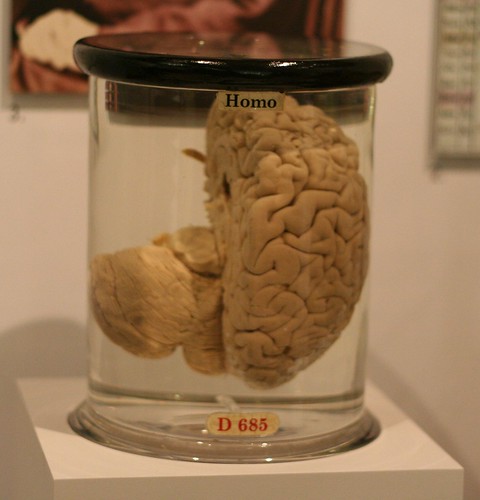
A few days ago, sitting alone in a room, I asked my powerful computer “If FREE WILL exists, where does it come from?”
To my surprise, soon many answers began popping up on my screen, each window containing a separate response and thread of justification. I suppose that’s what happens when you type the question into your IM away message and you have chatty friends. While the responses themselves varied widely, the interesting aspect is that everyone seems to have their own slightly different definition of free will, which is obviously a hindrance to any existential discussion. The best definition of free will is one I heard from my co-founder Leith. He defines free will as:
“the ability to make a choice such that that choice is not computable by a third party given the same inputs”
Now, that is a good definition because it is a statement that is both testable and fits within the popular notion of free will. Namely, the definition implies that if you have free will, then you have the ability to make choices that are not predictable by a third party. But, what kind of third parties?
The Case of Superbrains
Let’s say that not everything that we might want to apply the label of “having free will” to has the same computational capability. In other words, you have a brain, but there may exist entities out there that have brains with more computational capability or less computational capability. By computational capability, I mean that in the sense of computability, not speed. So while Johnny Boy may be faster at doing long division than you, he doesn’t have any additional computational CAPABLITY, because you could learn how to do and master long division yourself as well. On the other hand, you have more computational capacity than someone suffering from anterograde amnesia. Let’s call someone with more computational capability than yourself a Superbrain. God is a Superbrain. In fact, God is a Superbrain that knows everything. We can clearly see that if a Superbrain exists, then they could compute your choice given the same inputs. Thus you have no free will.
The Case of Equal Brains
Let’s say that either Superbrains don’t exist or they don’t really concern you because you don’t usually encounter Superbrains while walking to the bus stop. In that case, everyone has roughly the same hardware and hence the same computational capabilities. However, then our working definition of free will cannot hold, by the property of symmetry (or should I say asymmetry). That is, there cannot exist a choice that is computable by one party, but not by a third party, since everyone has the same computational capabilities. Practically speaking, what that means is, if I can choose the meatloaf sandwich, then another person with all the same data that my brain has, would go for the meatloaf sandwich as well. Hence, no free will in the case of equal brains either.
What we have shown is that either free will doesn’t exist or we have a bad definition of it.
Perhaps another definition of free will be more useful. I propose a definition of free will which defines it as a perception, and more specifically, as a feeling, in the same semantic class as terms like excitement, anxiety, or depression. A feeling, or emotion, is a pattern of electrical firings in the brain coupled with a certain biochemical signature. Thus, like with other emotions, on certain days I feel like I have more “free will” than other days and I have no "free will" when I am asleep. Under this definition, “free will” is the antonym of helplessness.
Why has the concept of free will been such a central topic of obsession over the ages? I think because the concept of free will is a “thinker trap”--our brains get stuck in it whenever we think about it. One theory I have is that the thing that makes catchy songs catchy is that all catchy songs have the property that the end of some segment in the song fits well with the beginning part of that segment, forming a loop. We can’t get the song out of our head because our brain keeps falling into that loop (if we don’t remember what the boring part of the song was) and so the song never finishes and our brain just ends up storing it that way.
Similarly, our minds get stuck on the concept of “free will” because it is a paradox in the same sense that “jumbo shrimp” is an oxymoron. The only difference is that that there are a few more deductive steps between the words “free” and “will” so it’s not as obvious to us.
Tuesday, December 04, 2007
3
Politicians and Moms are Right, but Partially So
Once every three years, the Department of Education participates in the Program for International Student Assessment (PISA), which is a study comparing 15-year-olds' performance in reading literacy, mathematics literacy, and science literacy in 57 participating countries. In particular, this latest assessment focused on science literacy, which the test's methodology defines as
Now, whenever I hear discussion concerning the academic performance of American students in the context of international comparison, it is usually from two types of sources: politicians and moms.
By politicians, I mean mainstream news sources and personalities that draw upon the popular urban legend meme of the US being the worst in education around the world in order to work a crowd.
Being an immigrant, by moms I mean this of course:
So, what does the report show? US students scored 489, on a test where the mean and standard deviation have been normalized respectively to 500 and 100. So yes, the report does seem to support the idea that US students underperform their international peers. However, if you break down the data more closely you'll find two interesting features.
Firstly, they do a categorically analysis of the data by racial group, which shows very statistically significant disparities in the scores between different racial groups. They range the gamut from an average score for black students of 409 to an average score of white non-Hispanic students of 523. The state of the American education performance in a nation that is itself multi-cultural and multi-societal, is a complex and non-homogeneous issue. There are definitely serious problems and widening gaps in education performance that are developing in America, but the data suggests to me that uniform across-the-board type policies, such as No Child Left behind, or universal minimum wages for teachers may not be all that beneficial, and potentially harmful, to the overall big picture. Instead target areas which are weighting down our national average should be pinpointed as areas to take a closer look at, and the best policies in those specific areas considered. But of course, this type of fine-grained debate never happens in the mainstream discourse.
In comparison, another feature of this study, and similar types of studies, that further aggravates this effect (of American students' underperformance) is that the distribution of the participating countries in the study is heavily skewed. In the list of member countries shown in the report, I noticed that the vast majority of the regions tested are in Europe and Australia. Not only are these countries much more racial homogeneous, making the comparison to a heavily multi-racial US an ill one, most of these countries are composed primarily of the "non-Hispanic" white population that scored the highest in the US breakdown. Let's not even address the issue of bias in question construction. Sadly, the entire continent of Africa is not included in the study.
What can moms learn from this study? The report also presents a limited what's called decile analysis of the scores. That means they break down the average scores in the 0%-10% range, 10%-20%, ..., 90%-100% range, etc. What the study found is that in the 90th percentile, a.k.a. 90%-100% range the US students scored 628, compared to a lower 622 for international students in the 90th percentile. That means, if you are an immigrant mom, and in the position to wonder which country would provide the best education for your child, you should have no qualms about having your children educated in the US. There are many good schools and almost any immigrant hub (read: major metropolitan area) in the US has some of the best schools in the world.
Read the report for yourself. It has some fun sample questions from the test that was given to the 15 year olds.
Highlights from PISA 2006: Performance of US 15-Year-Old Students
an individual’s scientific knowledge and use of that
knowledge to identify questions, to acquire new
knowledge, to explain scientific phenomena, and
to draw evidence-based conclusions about sciencerelated
issues, understanding of the characteristic
features of science as a form of human knowledge
and enquiry, awareness of how science and
technology shape our material, intellectual, and
cultural environments, and willingness to engage in
science-related issues, and with the ideas of science,
as a reflective citizen (OECD 2006, p.12).
Now, whenever I hear discussion concerning the academic performance of American students in the context of international comparison, it is usually from two types of sources: politicians and moms.
By politicians, I mean mainstream news sources and personalities that draw upon the popular urban legend meme of the US being the worst in education around the world in order to work a crowd.
[sample politician at a rally]
"...the US has the lowest reading and math scores worldwide. Our children are our future and we need more funding to pay our teachers today!"
Crowd: "Yeah!!"
Being an immigrant, by moms I mean this of course:
"You know when I was your age in Soviet Russia, we were doing vector calculus and number theory in middle school. In the snow. Uphill. This American education is rotting your brain."
So, what does the report show? US students scored 489, on a test where the mean and standard deviation have been normalized respectively to 500 and 100. So yes, the report does seem to support the idea that US students underperform their international peers. However, if you break down the data more closely you'll find two interesting features.
Firstly, they do a categorically analysis of the data by racial group, which shows very statistically significant disparities in the scores between different racial groups. They range the gamut from an average score for black students of 409 to an average score of white non-Hispanic students of 523. The state of the American education performance in a nation that is itself multi-cultural and multi-societal, is a complex and non-homogeneous issue. There are definitely serious problems and widening gaps in education performance that are developing in America, but the data suggests to me that uniform across-the-board type policies, such as No Child Left behind, or universal minimum wages for teachers may not be all that beneficial, and potentially harmful, to the overall big picture. Instead target areas which are weighting down our national average should be pinpointed as areas to take a closer look at, and the best policies in those specific areas considered. But of course, this type of fine-grained debate never happens in the mainstream discourse.
In comparison, another feature of this study, and similar types of studies, that further aggravates this effect (of American students' underperformance) is that the distribution of the participating countries in the study is heavily skewed. In the list of member countries shown in the report, I noticed that the vast majority of the regions tested are in Europe and Australia. Not only are these countries much more racial homogeneous, making the comparison to a heavily multi-racial US an ill one, most of these countries are composed primarily of the "non-Hispanic" white population that scored the highest in the US breakdown. Let's not even address the issue of bias in question construction. Sadly, the entire continent of Africa is not included in the study.
What can moms learn from this study? The report also presents a limited what's called decile analysis of the scores. That means they break down the average scores in the 0%-10% range, 10%-20%, ..., 90%-100% range, etc. What the study found is that in the 90th percentile, a.k.a. 90%-100% range the US students scored 628, compared to a lower 622 for international students in the 90th percentile. That means, if you are an immigrant mom, and in the position to wonder which country would provide the best education for your child, you should have no qualms about having your children educated in the US. There are many good schools and almost any immigrant hub (read: major metropolitan area) in the US has some of the best schools in the world.
Read the report for yourself. It has some fun sample questions from the test that was given to the 15 year olds.
Highlights from PISA 2006: Performance of US 15-Year-Old Students
Animals of the Internet Refuse to be Adorable in Support of the Writers' Strike
Oh, those snarky animals!
Wednesday, September 26, 2007
0
Saturday, September 08, 2007
2
"The Solution"
The following is a link to a transcript, released today, of a speech titled "The Solution" delivered by Usama Bin Laden, the FBI's most wanted terrorist. The speech is addressed to the American people, commemorating the sixth anniversary of the 9/11 attacks. It is Bin Laden's first public communications in almost three years. I have posted the link to the PDF of the transcript here because, ironically, it is quite hard to find it on any of the news sites.
The speech itself is well written and worth a read. Keep in mind that it is a translation from Arabic.
"The Solution" transcript.pdf
The speech itself is well written and worth a read. Keep in mind that it is a translation from Arabic.
"The Solution" transcript.pdf
Tuesday, August 07, 2007
0
The Automatic Brain
Have you ever driven to work, or walked to class and later had no memory of how you actually got there? Have you ever really needed to study for a test, but just found it impossible to concentrate, no matter what you tried? One theory that can explain this seemingly irrationality is that there is a second brain, a parallel brain, which operates below the observable threshold of consciousness. This is the primitive brain, whose structure we share with other animals.
This primitive brain has a much larger memory capacity. In contrast, the conscious brain has a rather limited memory; studies have shown that people generally can only keep about 7 numbers in our heads. That is why phone numbers in the US have that length.
Some would argue that this subconscious brain is what distinguishes people from each other mentally. This is what some people would define as experience. Observe the people’s reasoning and rationalization patterns. Are they all that different? If they were, we would not be able to hold a logical discussion. It is the primitive brain that distinguishes two people.
But what distinguishes humans’ and machines’ "brains"? Machines have an enormouse advantage over the conscious "reasoning" brain. A machine can store much more than 7 items in short-term memory. Also, the execution speed of sequential reasoning operations in a machine is much faster than in a human’s conscious brain. This is because human brain circuits are limited in their operation by chemical "neurotransmitters" that are physically bound by diffusion speed. Therefore latency of information transfer in humans is higher.
Humans are no match for machines in what you might consider the highest form of human ability, "logical reasoning." In fact there are many well-known efficient algorithms for performing this process.
However, humans do have advantages over machines. The advantage is in this primitive, animal brain. This subconscious brain has massive parallelism, which allow data storage and computation to happen simultanesouly across all circuits. This tradeoff of latency for massive bandwidth have allowed humans to outperform computers in most interesting tasks.
This advantage may be only temporary, however. Although the machines were initially designed for sequential execution, recently we have seen more and more growth in developing parallel computation. Large data-intensive parallel systems have been developed. Parallel hardware and parallel algorithms have allowed new types of programs, such as entire-genome mappers, world-champion chess programs, and search engines. Human brain evolution is relatively fixed. Machine brain evolution seems to be exponential. The cross-over point will be where amazing things start to happen.
© 2005
Tuesday, May 29, 2007
1
Meme Representation in Communities
 I wrote previously on clip culture, the trend of consuming content in smaller snippets (blogs, TV news, youtube, twitter) rather than in longer form (books, journal articles, films, Ph.D. dissertation). One perhaps non-trivial consequence is that shortening the form of communication actually changes the representation and content of the message. The shortened-form is not simply a summarized version of the original events and information.
Many years ago, when I was young and even more foolish than I am now, I tried writing a intelligent software algorithm for automatically trading stocks. These types of automated trading programs are commonly utilized by hedge funds and constitute a good portion of the current trading activity in our stock market. My idea was to have the software automatically analyze online news and market data and predict the direction on stocks using statistical machine learning methods. The program would be able to react much faster than it would take a human to read and understand news articles from thousands of sources.
Sounds like a lovely idea, right?
Well I'm not a billionaire today, so it obviously didn't work. And I'll tell you why. Essentially, predicting a stocks value reduces to predicting what people, in aggregate, think of a stock. In this regard, the content on the web is not an accurate representation of reality. Here's a crude demo. Consider for example the occurrences of the phrase "Microsoft is good" vs. "Linux is good" on the web. (Go ahead, Google it) You might falsely conclude from this data that you should be buying Red Hat stock and dumping MS shares. However, we all know that this is just selection bias. For another example, check out We Feel Fine by Sepander Kamvar(a Stanford professor, Google employee, and great guy, btw). This is a cool design experiment and has some neat graphs, but I doubt that those percentages are an accurate representation of how Livejournal users actually feel. These kinds of aggregations always tend towards the manic-depressive while most of us just feel normal most of the time. The content of the web is not an accurate representation of reality, and this selection bias is exacerbated by clip culture.
This is not a new disease of the blogsphere though, but a condition that has always existed in media. Anyone that's browsed a bookstore or watched TV can observe that it's the loud, the sensationalistic that gets facetime. And this misrepresentation is an important issue, because you can't expect every single person to have to the time to check all the facts. It's not practical. Whether you like it or not, people go by what they hear and see and this slowly shapes and molds their perspectives and behaviors.
What is new though, is that for the first time in history we might be able to address these problems effectively. Because of the internet, collecting and aggregating all the information together is no longer an issue. Now that the information can be aggregated to one place, the problems of representation and fact-checking can be attacked head on. In the future, intelligent software agents will be able to do this fact-checking for us at a scale that no human reader could possibly do in a lifetime. These agents will classify all of the viewpoints on a topic and determine which are legitimate arguments and which are just re-hashings of old propaganda.
Finally, the average citizen will have a weapon against the rising influence of mass media.
Thursday, April 26, 2007
1
I Named a Chinese Book
So, one of my Aunties is a quite well-renowned chef and cooking instructor in Taipei. She has previously published several of her cookbooks and now lives in Toronto, where she continues to give master classes in Chinese cooking. For the past few years, she has been working on her latest book, which is also a Chinese cooking book, but presents the dishes in a style reminiscent of French cuisine. Her book is titled "中菜西吃", which literally translates into something like "Chinese-Dishes-Western-Eating". Basically, the connotation is that while the foods and recipes are traditional Chinese dishes, the presentation, or display is in a more non-traditional Western-like style.
Anyways, the literal translation obviously doesn't make for a very attractive book title, and she asked many of her Canadian friends for suggestions for the English title of the book, the book being completely bilingual throughout. Not satisfied with any of the suggestions, she called me up when I was in Taiwan to get my recommendation. I actually gave this quite a bit of thought, in order to come up with something catchy. Anyways, below is my end result (click to view detail) , which should be published later this year. What do you think?

Congratulations, Auntie!
Wednesday, April 25, 2007
0
Speech Synthesis + Wikipedia
Ever simply wanted an MP3 of a Wikipedia article that you could take on the go in your Ipod?? Ever wanted to save a bunch of articles so that you could listen to them during rush hour traffic??
Yeah, neither did I.
However, today I found myself writing a quick script to do just that and if you by chance answered "yes" to any of those questions above then you are in luck! It's almost as simple as it could possibly be. You just supply the topic in the URL and the script generates a direct download of the MP3 in response.
The basic format I use looks like this: http://madfast.com/wikiread.cgi?q=[YOUR QUERY]. There are also a bunch of secret parameters I added that can be used to change the voice and file format.
Here are some examples:
Go crazy.
http://madfast.com/wikiread.cgi?q=Robot
http://madfast.com/wikiread.cgi?q=Computational Biology
http://madfast.com/wikiread.cgi?q=台灣
Wednesday, February 21, 2007
0
On Clip Culture
One of the things that concerns me is that recently a vast majority of my information processing is reading these “snippets” of information instead of longer, more meaningful discussions. It’s not just a consequence of using Diffbot but I think where internet culture is headed towards– YouTube epitomizes the short-attention span cinema that is the trend. Perhaps due to the sheer number of news sources, these “info clips” are the only way to aggregate all these disparate sources sanely. Certainly its not for lack of longer original sources on the web. Plenty of journals and books are available online and corporations and governments publish many of their proceedings now in electronic documents online. The problem is current technology can't really deal with these types of sources. Have you ever had Google return a search result to U.S. Constitution or perhaps some company's SEC filing where the "real answers" might lie?
The hope of AI is the hope that we will eventually have a technology that can synthesize all these threads of information from the original sources into a longer, coherent story instead of relying on the "he said that he said that he said that he said" that is the current blogosphere. Theoretically, it would be able to synthesize over broader and deeper sets of data due to the increased temporary RAM compared to a human brain.
On an unrelated note, if you haven't already, check out the book God's Debris by Scott Adams. Yes, that's Scott Adams the Dilbert comic guy. It has some interesting ideas and even some pertaining to AI. It's also a free download.
Wednesday, January 17, 2007
1
An Unnatural Birth Has Occurred

In other primate news, a female chimpanzee at the Chimp Haven Home for Former Research Animals has given birth to a baby girl [Source]. This is surprising due to the fact that all of the chimp males at the facility have had vasectomies. Management at Chimp Haven is now planning to do DNA testing on all of the chimp males in order to identify the cause of the unauthorized birthing.
However, this testing is largely unnecessary as I am already certain as to what the results will be. If I can call to your attention that case documented in the film Jurassic Park, this is obviously a case of where the genetic experimentation that has been conducted on these former lab animals has permanently altered their DNA. Hence, resulting in the activation of the latent reptilian genes, producing a sex-reversal of the female specimens, and ultimately spawning the creation of the super-raptors, er, monkeys.
I, for one, welcome our new mutant-monkey overlords.
Thursday, November 16, 2006
11
Using Google Calendar in Microsoft Outlook


I've recently started using the Google Calendar as my main calendaring application. It's neat because its accessible wherever I go, and you can easily add appointments from email messages if you use Gmail. However, when I'm using my notebook, I like to use Outlook for email so that I can keep copies of everything locally. So, I started searching for a way to integrate Outlook with Google Calendar, and found this [link: Incorporate Google Calendar in Outlook]. It's a nice solution, but it involves downloading pieces of M$ crapware (Visual Studio 2005 Tools for Office Runtime, Office 2003 Update: Redistributable Primary Interop Assemblies) and an Outlook plug-in.
I, not a huge fan of installing unnecessary stuff, found a much easier way to integrate GCalendar with Outlook that is enough to meet my needs and requires installing nothing.
Behold!
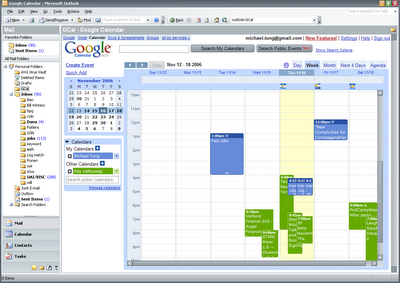

How it's done:
- In Outlook, right-click on the folder you want the GCal link to be in and do "New Folder...". Call it whatever you like.
- Right-click on your newly created folder and select "Properties...". Under the "Home Page" tab, put in the address of Google Calendar (http://www.google.com/calendar/render?pli=1) and select "Show home page by default for this folder."
- Click ok, you're all done.
One drawback of this method, is that you are not really using the Outlook calendar, so its not really a solution for you folks in corporate world on MS Exchange. But if you're happy using Google as your main calendar store, this'll be fine!
Wednesday, September 20, 2006
0
When Disgruntled Laptops Attack Their Masters
So, this is what happened at work this morning. I think the pictures are pretty self-explanatory. Apparently, the smoke detectors in our 8-story tower are only for decorative purposes, since despite the thick black smoke and smell, nothing happened until someone manually pulled on the fire alarm. Comforting, eh?
 On the other hand, my personal notebook is a Dell, too, that I've been using almost 4 years with no problems.
More coverage here:
Valleywag
 On the other hand, my personal notebook is a Dell, too, that I've been using almost 4 years with no problems.
More coverage here:
Dell battery explodes at Yahoo HQ, hundreds evacuate (Engadget)
Flickr shots of the eventValleywag